Modern infrastructure requires drainage systems that can manage surface water efficiently while withstanding pedestrian, vehicular, and industrial loads. Whether installed in roadways, industrial facilities, commercial developments, or other infrastructure projects, trench grates play an important role in maintaining safe and effective surface drainage.
The right trench grate must provide both adequate water-entry capacity and the structural strength required for its intended application.
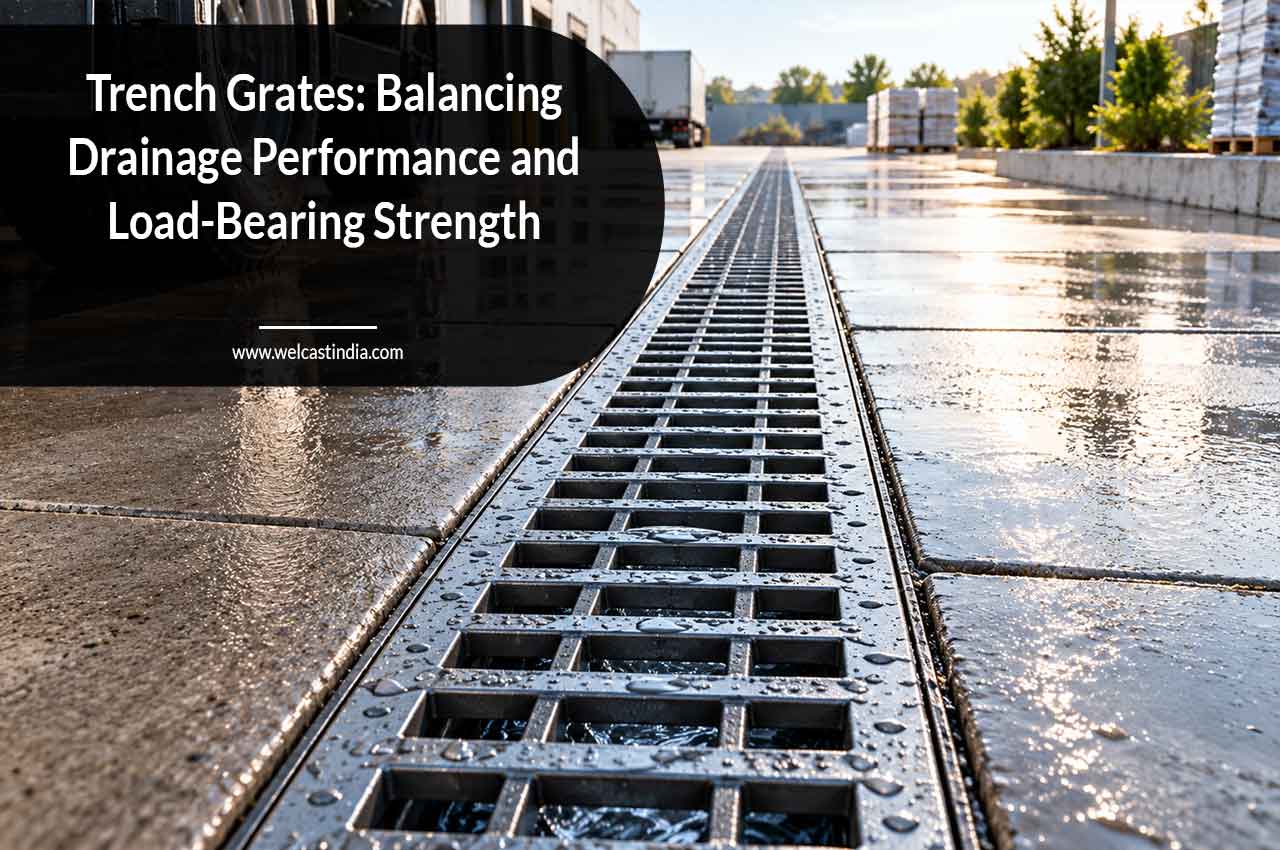
Trench grates are installed over linear drainage channels, allowing surface water to enter the drainage system while providing a safe and durable load-bearing surface above the channel.
Properly designed grating solutions can help:
The size, shape, and arrangement of grate openings are important because they influence both drainage capacity and user safety.
A trench grate must be designed for the loads it is expected to experience throughout its service life.
Depending on the market and application, drainage grates may be specified according to standards such as EN 124, AS 3996, FACTA classifications, AASHTO requirements, or other applicable customer and municipal specifications.
Correct load-class selection helps prevent excessive deformation, premature wear, or failure.
Ductile iron and grey cast iron are widely used for drainage grates depending on the required design, load class, and application.
Ductile iron provides high strength and toughness, making it particularly suitable for demanding applications. Grey cast iron may also be used where appropriate to the product design and specified performance requirements.
Protective coatings can be applied according to customer requirements to improve surface protection and corrosion resistance in particular environments.
Trench grates can also incorporate features such as:
These features can improve security, ease of inspection, and maintenance while helping keep the grate correctly positioned during use.
Even properly engineered drainage grates require periodic inspection and maintenance.
The performance of a trench grate depends on more than load rating alone. Important factors include material quality, casting consistency, dimensional accuracy, structural design, surface finish, fitment, and manufacturing control.
Welcast India manufactures ductile and grey cast iron grates and frames for municipal, industrial, and infrastructure applications.
Welcast can support customers with standard as well as customised products based on drawings, load requirements, dimensions, coatings, locking arrangements, and project specifications.
Effective trench drainage requires the right balance between water-entry performance and structural strength.
A properly designed trench grate should provide adequate drainage capacity while safely supporting the loads associated with its intended application. Appropriate material selection, engineering design, manufacturing quality, and regular maintenance all contribute to long-term performance.
Answer: Trench grates cover linear drainage channels while allowing surface water to enter the drainage system and providing a safe surface above the channel.
Answer: The grate must safely withstand the pedestrian, vehicular, or industrial loads expected at the installation location.
Answer: Ductile iron and grey cast iron are commonly used depending on the required design, load class, and application.
Answer: Their openings allow water into the channel while restricting some larger debris. Regular cleaning is still necessary to maintain effective drainage.
Answer: Inspection and cleaning frequency depends on the location, traffic, environmental conditions, and amount of debris accumulating around the drainage system.
Answer: They are commonly used in roads, industrial facilities, commercial areas, parking facilities, pedestrian zones, and municipal drainage systems.